- MSc thesis
- Γλωσσική Εκπαίδευση για πρόσφυγες και μετανάστες (LRM)
- 29 July 2026
- Αγγλικά
- 114
- ΕΛΕΝΗ ΣΑΜΣΑΡΗ
- Οδυσσέας Ευαγγέλου | Νεκταρία Παλαιολόγου
- non-formal education, unaccompanied minors, refugee and migrant adolescents, language acquisition, social inclusion, reception centers, Greece.
- LRM64
- 1
- 30
-
-
This study evaluates the role of non-formal education as a tool for the linguistic and social inclusion of unaccompanied refugee and migrant adolescents in Greece. Even though a significant number of unaccompanied minors are residing in reception centres across the country, the research that already exists on their educational experiences is very limited, especially in non-formal settings, as most studies focus on formal education contexts. This is a qualitative research that aims to address this gap by examining how participation in non-formal education programmes affects Greek language acquisition and social inclusion, whay teaching practices are followed and what challenges adolescents face in their language-learning experiences.
The research takes place in an NGO-operated reception centre in Thessaloniki, Greece called "Το Σπίτι της ΑΡΣΙΣ" ("The House of ARSIS") that offers accommodation for unaccompanied teenage boys, aged 12 to 17. The research data was generated through semi-structured interviews with ten adolescent participants (n=10) and three staff members ( a teacher, a social worker and a caregiver) (n=3). Data were then analysed using thematic analysis (Braun & Clarke, 2006).
The findings show that non-formal education plays a very important role in supporting both language development and social inclusion with culturally responsive and translanguaging pedagogical practices that help create learner's sense of belonging and engagment. However, the study also identifies some challenges. When it comes to the adolescents, there are mostly psychosocial issues, like worry about their families and uncentainty about the future, and there are also some structural ones, such as bureaucratic burden and unstable residency patterns, which can limit that impact of non-buraucratic education in this setting. Overall, the study contributes, as it is already mentioned, to an underdeveloped research area in the Greek contect, by offering potential impact on pedagogical practice and educational making withic Europe in contexts of receptions centres.
-
- Hellenic Open University
- Attribution-NonCommercial-NoDerivatives 4.0 Διεθνές
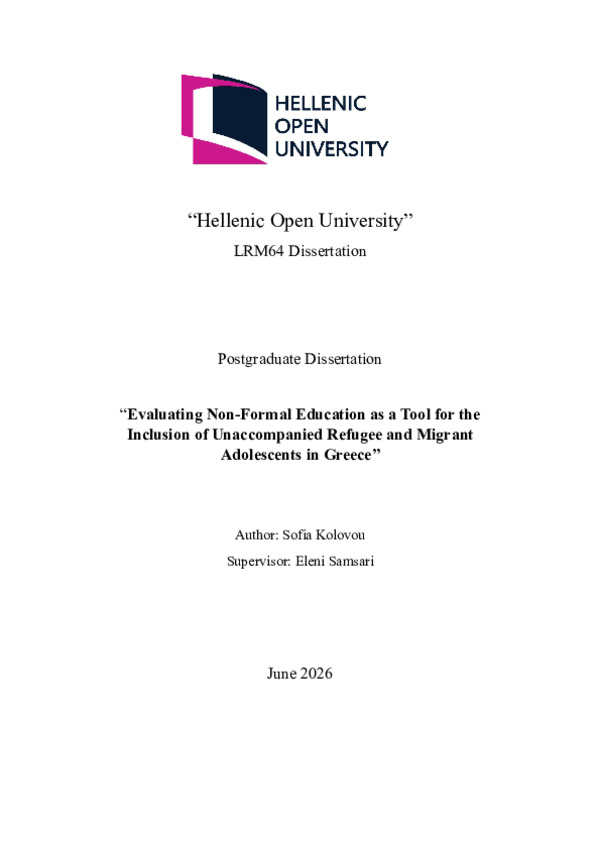
Evaluating Non-Formal Education as a Tool for the Inclusion of Unaccompanied Refugee and Migrant Adolescents in Greece
Αξιολογώντας τη Μη Τυπική Εκπαίδευση ως Μέσο για την Κοινωνική Ένταξη Ασυνόδευτων Προσφύγων και Μεταναστών Εφήβων στην Ελλάδα (greek)
Main Files
 LRM64 Dissertantion by Sofia Kolovou
Description: LRM64_Dissertation_Sofia_Kolovou.pdf (pdf) Book Reader
Size: 1.7 MB
