- MSc thesis
- Protection of Cultural Heritage and Monuments of Nature from the Effects of Climate Change (CCC)
- 27 September 2026
- Αγγλικά
- 80
- ZOI SAKKI,SOFIA SOTIROPOULOU
- ZOI SAKKI,SOFIA SOTIROPOULOU
- Preventive Conservation, Museum Environmental Management, Climate Change, Small Museums, Mediterranean Climate, Western Greece
- Protection of Cultural Heritage and Monuments of Nature from the Effects of Climate Change (CCC)
- 2
- 19
- Διπλωματική εργασία με θέμα τη βιώσιμη διαχείριση των εσωτερικών περιβαλλοντικών συνθηκών σε μικρά μουσεία της Δυτικής Ελλάδας στο πλαίσιο της κλιματικής αλλαγής.
-
-
Abstract
Museums play a vital role in the preservation and transmission of cultural heritage, preserving objects of historical, artistic and scientific importance for present and future generations. However, the long-term conservation of museum collections is increasingly challenged by environmental factors exacerbated by climate change. Rising temperatures, more frequent extreme weather events and fluctuations in relative humidity pose significant risks to museum collections, especially in Mediterranean regions where climatic conditions are already demanding.
Preventive conservation has become a fundamental approach to the care of museum collections, focusing on the management of environmental conditions to minimize degradation. Temperature, relative humidity, light exposure and air quality are among the most important factors affecting the physical and chemical stability of museum objects. Although international organizations such as ICOM, ICCROM, ASHRAE and the European Standardization Bodies (EN) provide widely accepted recommendations for the environmental control of museums, their implementation is often difficult in small museums operating under Mediterranean climatic conditions. High summer temperatures, seasonal humidity fluctuations, strong solar radiation and limited financial and technical resources make sustainable environmental management particularly difficult.
This thesis focuses on the sustainable management of indoor environmental conditions in small museums located in Western Greece, using the wider Mediterranean region as a comparative framework. The research aims to examine how these museums manage their indoor environmental conditions, identify the main risks affecting their collections, evaluate current practices in relation to international recommendations and propose practical, sustainable and cost-effective strategies suitable for institutions with limited resources.
The specific objectives of the study are to examine the principles of preventive maintenance and their application in museums, to investigate the effects of temperature, relative humidity, light and air quality on different categories of museum collections, to evaluate the application of international environmental standards under Mediterranean conditions, to identify the challenges faced by small museums in Western Greece, to analyze existing environmental management practices through selected case studies and to propose realistic proposals for improving indoor environmental management.The research adopts a qualitative methodology based on a comprehensive literature review and comparative analysis of case studies. The literature review examines scientific publications, technical reports and international guidelines related to preventive conservation, museum environmental management, sustainability and adaptation to climate change. The practical part of the research includes four museums in Western Greece representing both archaeological and folklore collections. These case studies were selected according to criteria such as the size of the institution, the diversity of the collections, the available resources and the representativeness of Mediterranean conditions. The museums include a wide range of organic materials, such as wood, paper and textiles, inorganic materials such as stone, ceramics and metals, as well as complex objects with different environmental sensitivities. This diversity allowed the study to examine environmental management practices under different collection requirements and museum conditions.
Data were collected primarily from institutional documentation, environmental monitoring records, published reports and available technical information. Additional information was obtained through contact with museum professionals, including brief interviews and structured questionnaires, where available. The information collected was analyzed using a comparative and thematic approach to identify common environmental challenges, current management practices and practical solutions. The findings were then compared with international standards and professional recommendations on preventive maintenance to assess their applicability to the selected museums. -
Η παρούσα διπλωματική εργασία εξετάζει τη βιώσιμη διαχείριση των εσωτερικών περιβαλλοντικών συνθηκών σε μικρά μουσεία της Δυτικής Ελλάδας, στο ευρύτερο πλαίσιο των προκλήσεων που θέτει η κλιματική αλλαγή για τη διατήρηση της πολιτιστικής κληρονομιάς. Η αύξηση της θερμοκρασίας, οι μεταβολές της σχετικής υγρασίας και η συχνότερη εμφάνιση ακραίων καιρικών φαινομένων επηρεάζουν σημαντικά τη μακροπρόθεσμη διατήρηση των μουσειακών συλλογών, ιδίως στις μεσογειακές περιοχές.
Η εργασία βασίζεται στις αρχές της προληπτικής συντήρησης, δίνοντας έμφαση στον έλεγχο της θερμοκρασίας, της σχετικής υγρασίας, του φωτισμού και της ποιότητας του αέρα ως βασικές παραμέτρους για την προστασία των συλλογών. Παράλληλα, εξετάζεται η εφαρμογή διεθνών προτύπων και κατευθυντήριων γραμμών σε συνθήκες που χαρακτηρίζονται από περιορισμένους οικονομικούς και τεχνικούς πόρους, όπως συμβαίνει σε πολλά μικρά μουσεία της Δυτικής Ελλάδας.
Η έρευνα ακολουθεί ποιοτική μεθοδολογία και συνδυάζει την ανασκόπηση της βιβλιογραφίας με τη συγκριτική ανάλυση τεσσάρων μελετών περίπτωσης μουσείων στη Δυτική Ελλάδα, οι οποίες περιλαμβάνουν αρχαιολογικές και λαογραφικές συλλογές. Η συλλογή δεδομένων βασίστηκε σε διαθέσιμη τεκμηρίωση, περιβαλλοντικά αρχεία, δημοσιευμένες πηγές και επικοινωνία με επαγγελματίες των μουσείων. Τα ευρήματα αναλύθηκαν συγκριτικά και αξιολογήθηκαν σε σχέση με τις διεθνείς συστάσεις για προληπτική συντήρηση.
Η εργασία καταλήγει σε πρακτικές, βιώσιμες και οικονομικά εφικτές προτάσεις για τη βελτίωση της διαχείρισης των εσωτερικών περιβαλλοντικών συνθηκών σε μικρά μουσεία. Με αυτόν τον τρόπο, συμβάλλει στην προσαρμογή των μουσείων στις επιπτώσεις της κλιματικής αλλαγής, ενισχύοντας τη μακροπρόθεσμη προστασία των συλλογών και προωθώντας πιο ανθεκτικές και περιβαλλοντικά υπεύθυνες πρακτικές διαχείρισης της πολιτιστικής κληρονομιάς.
-
- Hellenic Open University
- Αναφορά Δημιουργού 4.0 Διεθνές
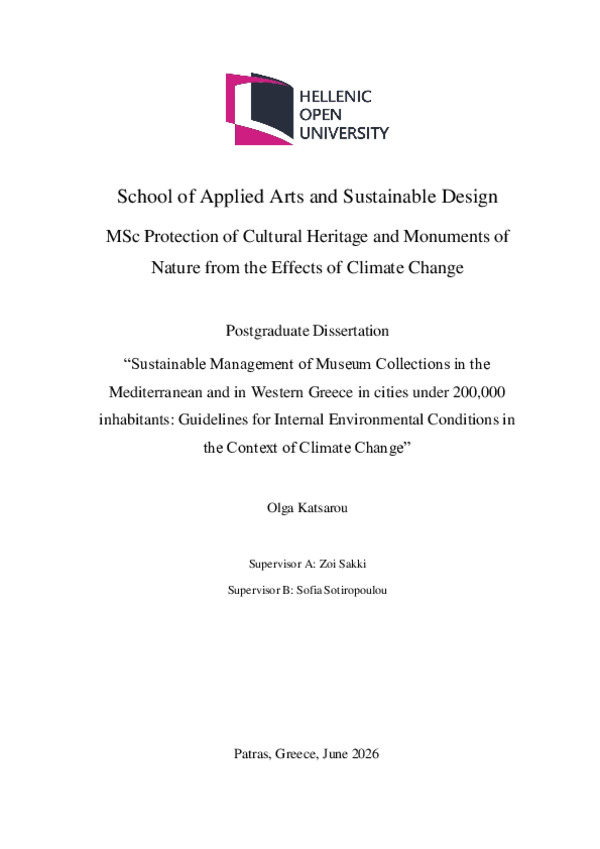
“Sustainable Management of Museum Collections in the Mediterranean and in Western Greece in cities under 200,000 inhabitants: Guidelines for Internal Environmental Conditions in the Context of Climate Change”
«Βιώσιμη διαχείριση μουσειακών συλλογών στη Μεσόγειο και τη Δυτική Ελλάδα, σε πόλεις με πληθυσμό κάτω των 200.000 κατοίκων: Κατευθυντήριες γραμμές για τις εσωτερικές περιβαλλοντικές συνθήκες στο πλαίσιο της κλιματικής αλλαγής» (greek)
Main Files
 Sustainable Management of Museum Collections – Olga Katsarou
Description: Thesis-Dissertation-Olga Katsarou June -2026 with references.pdf (pdf) Book Reader
Size: 2.1 MB
